

Overview

Add a logo and other content
Follow these steps to customize the visual and textual content of your public form:Step 1: Navigate to the Content and attachments tab
To get started, select the Content and attachments tab in the public form editor.Step 2: Add a logo image
Add a logo image by clicking the dashed Add a logo tile and uploading your organization’s logo, or by dragging an image file onto the tile. This will appear at the top of your public form. Horizontal banners tend to look best. The image should have a maximum width of 640px and a maximum height of 100px.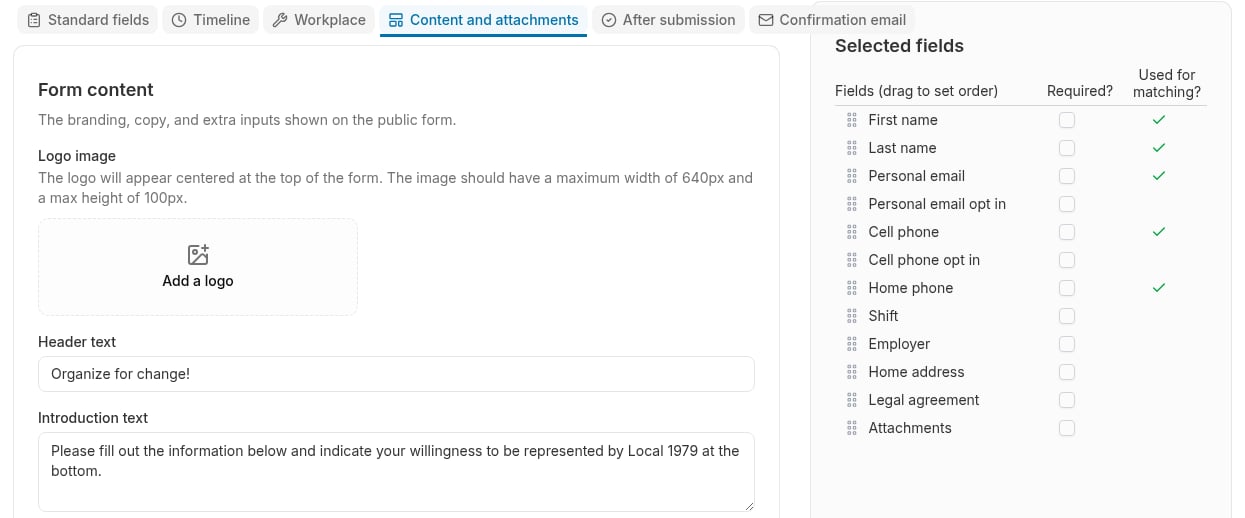
- Click the Add a logo tile (or drag an image file onto it)
- Navigate to your logo file on your computer
- Select the image file
- Click Save at the bottom of the form editor
- Click Remove below the logo preview
- Click Save at the bottom of the form editor
- Click Replace below the logo preview and select a new logo
- The new logo will replace the old one when you save
When you duplicate a form, the system attempts to copy the logo. If logo copying fails, you’ll see a warning message and will need to re-upload the logo to the duplicated form.
Step 3: Add Header Text
Below the logo, you can enter Header Text. This could be your organization’s tagline or any title of your choosing. This is the main title that appears at the top of your form, below the logo (if you uploaded one). Default: If you leave this blank, the form NAME (from the top of the form editor) is used as the header. Examples:- “Worker Interest Card”
- “Join Our Campaign”
- “2025 Training Registration”
- “Tell Us Your Story”
- “Sign Up to Learn More”
- Keep it short (under 10 words)
- Use action-oriented language
- Make it welcoming and clear about the form’s purpose
- Consider your audience’s language and perspective
Step 4: Add Introduction text
In the Introduction field, add a brief explanation or instructions for the form recipients. This is a good place to tell them what actions to take with the form. This text appears below the header and above the form fields. Use it to:- Explain the purpose of the form
- Set expectations (how long it takes, what happens next)
- Provide context or motivation
- Include any necessary disclaimers
- The introduction text supports line breaks
- Keep paragraphs short for readability
- Consider bullet points for multiple ideas
- Don’t make it too long—most people won’t read more than 2-3 short paragraphs
- Answer “What is this for?” and “Why should I fill this out?”
- Set realistic time expectations
- Mention what happens after submission
- Use welcoming, inclusive language
- If required by law, include NLRB disclaimer: “Filling out this form does not obligate you to do anything or join anything.”
Customize your form with links and HTML styling
The Introduction text, Form submission button text, and Legal agreement fields support hyperlinks and HTML tags, allowing you to format and style your text.For additional styling needs, please contact in-app support or support@broadstripes.com
Step 5: Customize the submission button
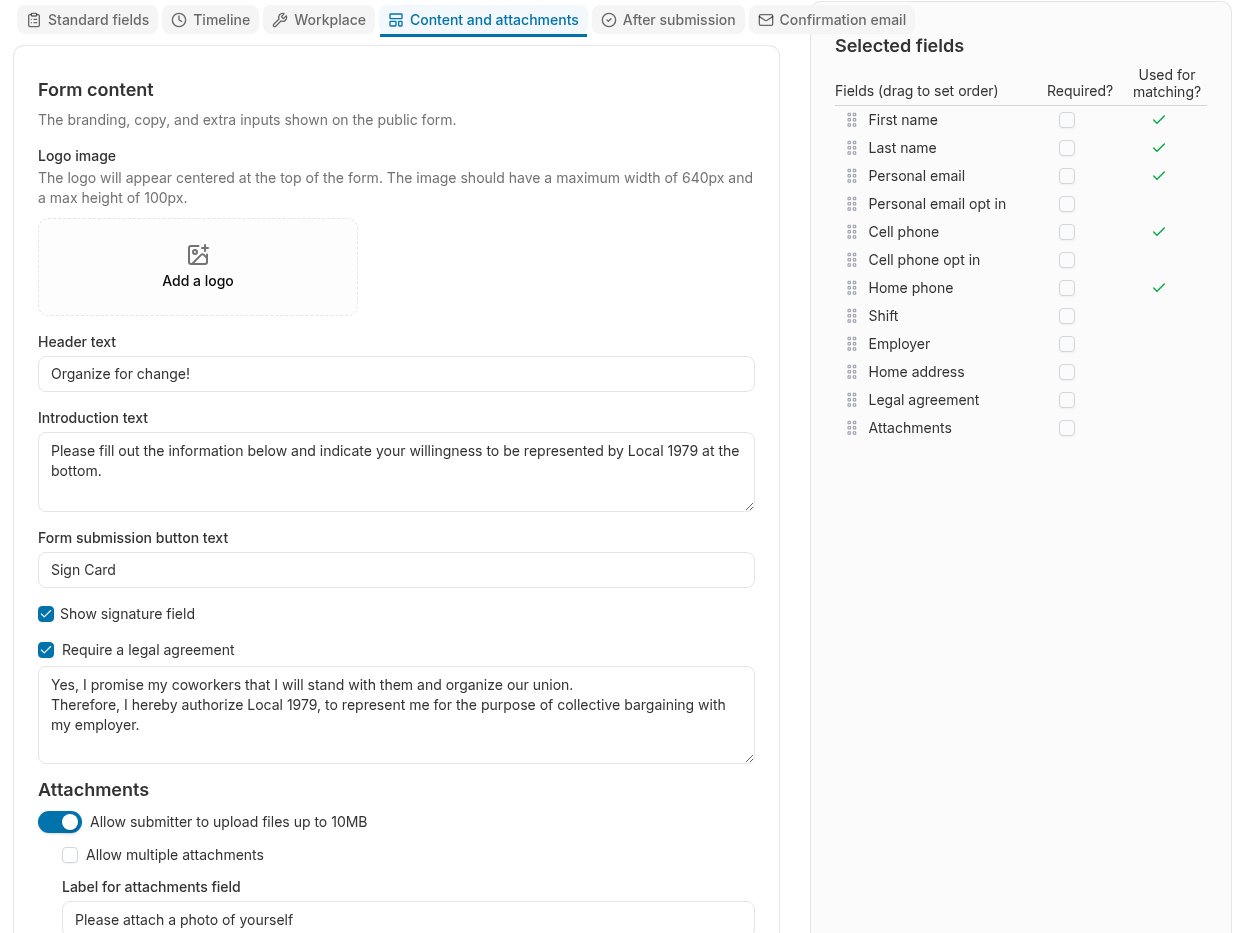
Customize your form’s submission button with a call to action. Create your custom text for submitting in the “Form submission button text” field. This is the label on the button that submits the form. Default: “Submit” Example alternatives:- “Join Us”
- “Sign Up”
- “Register”
- “Submit My Interest Card”
- “Count Me In”
- “I’m Interested”
- “Save My Information”
- Use action language that reflects what the user is doing
- Keep it short (1-3 words)
- Match the tone of your campaign
- Consider what commitment level you’re asking for (avoid “JOIN THE UNION” if this is just an interest card)
Step 6: Add a signature field (optional)
Select the “Show signature field” checkbox to allow submitters to sign the form using their mouse or finger. When enabled:- A signature capture field appears near the bottom of the form (above the submit button)
- Users can draw their signature with a mouse (desktop) or finger (mobile)
- A “clear” link allows redoing the signature
- Instructions appear: “Use your mouse (or your finger on a phone or tablet) to enter your signature above”
- The signature is captured as an image and included in the PDF
- No signature field appears
- Form submission is faster and simpler
- Union authorization cards (may be legally required)
- Legal agreements or waivers
- Forms where you need proof of identity
- Official applications or nominations
- General interest forms
- Event registrations
- Casual sign-ups
- Any form where signature isn’t legally or procedurally necessary
If you enable the signature field, most users will expect it to be required even if you don’t mark it as required. Consider this when designing your form flow.
Step 7: Add a Legal agreement (optional)
You also have the option of including a section for a Legal agreement that a recipient must check before submitting the public form. Check the Legal agreement checkbox and enter the text of your agreement in the box below. This section has two parts: a checkbox to enable the legal agreement, and a text area for the agreement text. To add a legal agreement:- Check the box next to Legal agreement
- Enter your agreement text in the Legal agreement text text area
- The legal agreement will be added to your selected fields
- Mark it as required in the “Selected fields” panel on the Standard fields tab
- The legal agreement text displays near the bottom of the form (above signature if enabled)
- A checkbox appears next to or below the text
- The user must check the box to submit the form (if marked as required)
- Large text area for your agreement language
- Supports line breaks
- Supports HTML for formatting
- Placeholder: “I agree that…”
- Keep legal language as simple as possible
- Break complex agreements into short paragraphs or bullet points
- Consult with legal counsel for union authorization cards
- Include required NLRB disclaimers if applicable
- Don’t use legal agreements for casual sign-up forms—they reduce completion rates
- Legal agreement text appears in the order you set in “Selected fields” on the Standard fields tab
- It typically appears near the end of the form
- Most campaigns place it just before the signature field (if enabled) or just before the submit button
Step 8: Enable file attachments (optional)
Check the “Allow submitter to upload files up to 10 MB” box to let users attach files to the form submission. Supported file types include:- Most image/video files
- MS Office files
- OpenOffice files
- Plain text
- A file upload field appears on the public form
- Users can select and upload files
- Maximum file size: 10MB per file
- Uploaded files attach to the contact record in Broadstripes
- No file upload option on the form
- Photo uploads for badges or profiles
- Document submission for grievances or complaints
- Supporting materials for applications or requests
- Simple interest cards or sign-ups
- Forms where attachments aren’t relevant
- Concerns about inappropriate file uploads
Files are scanned and stored securely. Project members can view and manage attachments in the contact record. When you enable attachments, the attachment field is automatically added to your form’s selected fields. You control where it appears by dragging it in the “Selected fields” panel.
Allow multiple attachments
To permit multiple file uploads (with a total size limit of 10 MB), check the “Allow multiple attachments” box. This checkbox only appears if Allow submitter to upload files is enabled. When enabled:- Users can upload more than one file
- An “Add another file” button appears after selecting a file
- All uploaded files attach to the contact record
- Users can only upload one file
- Simpler interface
- Resume + cover letter uploads
- Multiple supporting documents
- Photo galleries
- Any scenario where one file isn’t enough
- Most forms only need single file upload
- Reduces complexity for users
Custom label for attachment field
You can also enter a descriptive label for the attachment field to inform form submitters about what kind of file(s) they should upload. This setting only appears if Allow submitter to upload files is enabled. Default label: “Attachments” Custom label examples:- “Upload your document”
- “Profile photo”
- “Supporting documents”
- “Proof of employment”
- “Badge photo”
Step 9: Save your work
How Content Appears on the Form
When someone opens your public form, they see (in order):- Logo (if uploaded) - centered at top
- Header text - main title
- Introduction text - explanatory paragraph(s)
- Required field notice - “Fields marked with an asterisk (*) are required”
- Form fields - in the order you configured
- Legal agreement text (if enabled this will appear in the order you set in “Selected fields” on the Standard fields tab) - with checkbox
- Signature field (if enabled) - with canvas and “clear” link
- Submit button - with your custom button text
How Attachments Work
When a form with attachments enabled is submitted:- File upload: User selects file(s) from their device
- Validation: Broadstripes checks file size (must be under 10MB)
- Storage: Files are uploaded to secure storage
- Attachment record: An attachment record is created and linked to the contact
- Availability: Files appear in the contact’s Attachments section in Broadstripes
- Go to the contact record in Broadstripes
- Click the Attachments tab
- All form-submitted files appear along with any other attachments for the contact
Testing Your Form Content
Before sharing your form widely:- Click Save to save your content changes
- Copy the public form URL from the Public forms page
- Open the URL in a private/incognito browser window
- Review all the content:
- Does the logo display correctly?
- Is the header clear and welcoming?
- Does the introduction provide enough context?
- Is the legal agreement text clear and accurate?
- Does the submit button text make sense?
- Submit a test entry
- Check the confirmation message (configured in the After submission tab)
Accessibility Considerations
Clear headings: The header text becomes the main heading for screen readers Simple language: Keep introduction text clear and concise for all literacy levels Legal agreement readability: Break complex legal text into short paragraphs Signature field: Includes clear instructions for all usersCommon Scenarios
Basic Interest Card
- Logo: Union logo
- Header: “Worker Interest Card”
- Introduction: “Want to learn more about organizing for better conditions? Fill out this card and an organizer will contact you.”
- Button: “Submit”
- Signature: Disabled
- Legal agreement: None
Union Authorization Card
- Logo: Union logo
- Header: “Union Authorization Card”
- Introduction: “By signing this card, you’re authorizing [Union] to represent you. Your signature does not obligate you to join the union or vote yes in an election.”
- Button: “Sign Card”
- Signature: Enabled
- Legal agreement: Full NLRB-compliant authorization language
Event Registration
- Logo: Campaign logo
- Header: “March Member Meeting”
- Introduction: “Join us March 15th at 6 PM for our monthly meeting. We’ll discuss upcoming actions and vote on proposals. Dinner will be provided.”
- Button: “Register”
- Signature: Disabled
- Legal agreement: None
Volunteer Sign-Up
- Logo: Organization logo
- Header: “Get Involved”
- Introduction: “We need volunteers for phone banking, door knocking, and event support. Sign up and we’ll match you with opportunities that fit your schedule and interests.”
- Button: “Sign Up”
- Signature: Disabled
- Legal agreement: None