

Overview
The Workplace tab allows you to create an employment relationship for each form submission. If you prefer not to, you can skip this tab and use the default settings.The Workplace tab only appears for person forms. Organization forms do not have this tab.
Why Collect Employment Information?
Employment relationships are central to labor organizing campaigns. Collecting employer information lets you:- Link workers to their employers (shops, departments, companies)
- Build shop lists and organizational charts
- Identify shop leaders and organizers
- Generate shop-specific reports
- Send targeted communications to specific workplaces
- Track organizing progress by location
Create an employment relationship on your public form
Follow these steps to configure employment collection on your public form:Step 1: Navigate to the Workplace tab
To get started, select the Workplace tab in the public form editor.Step 2: Enable employment creation
To include employment information, turn on the toggle in the Workplace card at the top of the tab (“Enable the worker submitting the form to identify where they work”). The record connected to the form submission will now be associated with an employer. The rest of the tab’s options stay grayed out until this toggle is on.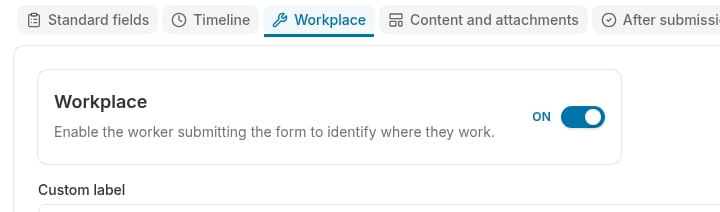
- An “Employer” field appears on the public form
- The submitter provides their employer information
- An employment relationship is created automatically
- The worker is linked to the organization in Broadstripes
Step 3: Create a custom label
Create a descriptive label for the employment input section using the Custom label field. Default: “Employer” Custom label examples:- “Where do you work?”
- “Your employer”
- “Company name”
- “Shop name”
- “Worksite”
Step 4: Choose the matching method
Next, use the “Choose the method by which the workplace for the employment will be identified:” dropdown. This dropdown controls HOW workers will identify their employer on the form.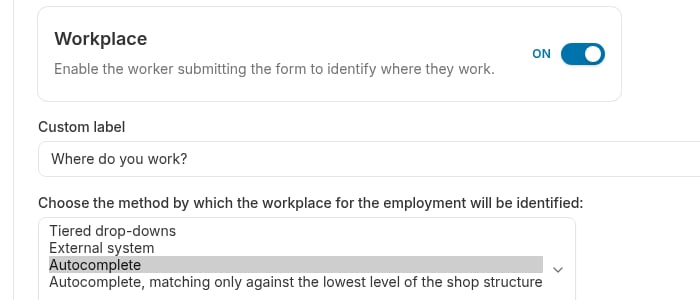
Tiered drop-downs
The form recipient will select their employment information via drop-down menus, starting with the highest level of employment and then department and subdepartment, if applicable. How it works:- Multiple dropdown menus appear on the form
- First dropdown shows parent organizations
- Second dropdown shows child organizations within the selected parent
- Additional dropdowns may appear for deeper hierarchies
- Campaigns with clear organizational hierarchies
- Large employers with multiple locations or departments
- First dropdown: Select your division (Northeast, Southeast, Central, West)
- Second dropdown: Select your facility (lists facilities in chosen division)
- Prevents typos and variations in employer names
- Forces structured data entry
- Easy for workers when hierarchy is clear
- Can be slow if hierarchy is deep or complex
- May confuse workers unfamiliar with the corporate structure
External system
Broadstripes will use the external system you choose to make an employment association. You will also choose which external system value will be matched. How it works:- A single text input field appears
- Worker enters an identifier from an external system (employer ID, shop number, etc.)
- Broadstripes matches the identifier to an existing organization
- Workers who know their employer ID or shop code
- Campaigns with integrated payroll or HR systems
- When you’ve imported organization data with external IDs
- Custom label: “Employee ID”
- External system: “Payroll System”
- Worker types: “E12345”
- Broadstripes finds the organization with external system ID “E12345”
- Fast for workers who know their ID
- Works well with HR system integrations
- Workers must know their ID
- Requires external system setup in Broadstripes
- Creates errors if worker enters wrong ID
Autocomplete
Broadstripes will automatically match existing shops/departments to recipients’ input. How it works:- A single text input field appears with autocomplete
- As the worker types, matching organization names appear
- Worker selects their employer from the list
- Matches against organization names at ALL levels of hierarchy
- Campaigns with many employers
- Workers who know their employer’s name but not the formal hierarchy
- Mobile-friendly forms (less tapping than tiered dropdowns)
- Worker types “acme”
- Autocomplete shows: “Acme Corporation”, “Acme West”, “Acme Manufacturing”
- Worker selects the correct one
- Fast and intuitive
- Works on mobile devices
- No need to understand organizational hierarchy
- May show too many results for common names
Autocomplete, matching only against the lowest level of shop structure
A form of auto-matching that will only match on departments at the lowest level (works best for projects with unique department names). How it works:- Same as Autocomplete above, but…
- ONLY matches organization names at the lowest (leaf) level of the hierarchy
- Excludes parent organizations from autocomplete results
- Campaigns where workers should only be employed at specific locations, not parent companies
- Avoiding confusion between “Acme Corporation” (parent) and “Acme Plant 3” (actual worksite)
- Ensuring workers are linked to the most specific level
- Organization hierarchy: Acme Corp → Acme Northeast → Acme Plant 3
- Regular autocomplete would show all three when typing “acme”
- Leaf node autocomplete ONLY shows “Acme Plant 3”
- Prevents workers from selecting parent organizations inappropriately
- Ensures precise location data
- Cleaner autocomplete results
- Requires well-structured organization hierarchy in Broadstripes
- May not show any results if hierarchy isn’t set up correctly
- Can confuse workers if the “leaf node” isn’t how they think of their employer
Step 5: Configure employer email notifications (optional)
A form can be set to automatically send the employer a copy of the recipient’s form submission. You will configure this option on the Confirmation email tab. This will require you to have contact information for the employer in your project, specifically an email address.See the Confirmation email tab to enable automatic email messages to employers and others after form submission.
Step 6: Enable multiple employments (optional)
Under the Multiple employments heading, check the “Enable submitters to identify multiple workplaces (creating multiple employments)” box to enable form recipients to create multiple employment relationships.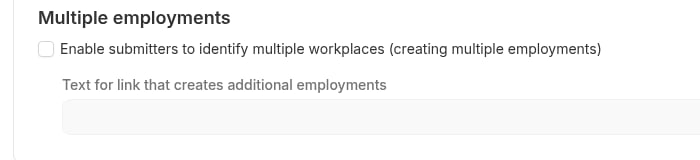
- Workers can add more than one employer on the form
- A link appears allowing them to add additional employments
- Useful for workers with multiple jobs or who work at multiple locations
- Workers can only specify one employer
- Simpler form experience
- “Add another job”
- “Add second workplace”
Step 7: Save your work
Once you’ve configured your employment options, click Save or move on to the next tab to continue customizing your form.Common Configuration Examples
Basic Manufacturing Shop Organizing Configuration:- ☑ Create an employment
- Custom label: “Where do you work?”
- Selection method: Autocomplete (leaf node only)
- ☐ Allow multiple employments: No
- ☑ Create an employment
- Custom label: “Your location”
- Selection method: Tiered drop-downs
- ☐ Allow multiple employments: No
- ☑ Create an employment
- Custom label: “Current employer”
- Selection method: Autocomplete
- ☑ Allow multiple employments: Yes
- Additional employment label: “Add another job”
Integrated HR external system IDs
Configuration:- ☑ Create an employment
- Custom label: “Employer ID”
- Selection method: External system
- External system: “HR System”
- ☐ Allow multiple employments: No