

Overview
An important part of many kinds of organizing is the identification of leaders within the bargaining unit or worker group. Leadership is usually defined by roles. Labor organizing (internal or external) often uses “Committee” and “Key Leader,” while “Activist” or “Mobilizer” are more common in community organizing. With Broadstripes, it is simple to set up leader roles to suit the style of organizing you’re doing.Set up new leader roles
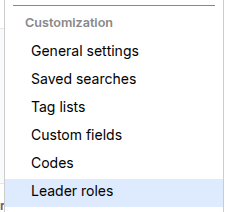
- Click the Project settings icon in the upper right corner of any page (or press Ctrl-K / ⌘K), then choose Leader roles.
This takes you to the leader role index page that lists any existing roles in your project. - Click on the button to add + New Leader Role.
- Give the new role a one- or two-word name that’s meaningful to the organizers on your campaign. (This is the text that will appear on-screen and in reports.)
- Add a description (optional). If your project has many roles, it can be useful to create a short descriptive sentence for each.
- Enter a position number. The position number conveys where the role fits in the hierarchy of leadership. It determines where the role will appear in the leader role drop-down chooser as seen by your end users.
- Check Represents leadership if you are creating some roles that do not represent leadership and wish to have the ability to distinguish between people in leadership roles and those with non-leadership roles. An example of a non-leadership role is a “Target,” a person who may have influence in the bargaining but who has not yet committed to using that influence to support your campaign’s goals.
-
Configure the coverage settings for this role. New leader roles open with both coverage checkboxes already enabled, so you only need to change these if you want different behavior for this role:
- Leaders are covered — When checked, people with this role are counted as covered in Broadstripes’ automatic calculation of coverage within the shop/department turf. (This organizing metric can be shown on the Turf Panel and added to status reports at your discretion.)
- Followers are covered — When checked, the followers of leaders with this role are also counted as covered. For example, if a “Committee” leader has this option enabled, anyone assigned to that leader will automatically be counted as covered, even if they don’t have a leadership role themselves.
Followers are covered depends on Leaders are covered. If you uncheck Leaders are covered, the Followers are covered option is automatically cleared and disabled — followers cannot count as covered if their leaders do not. Re-checking Leaders are covered restores Followers are covered to checked.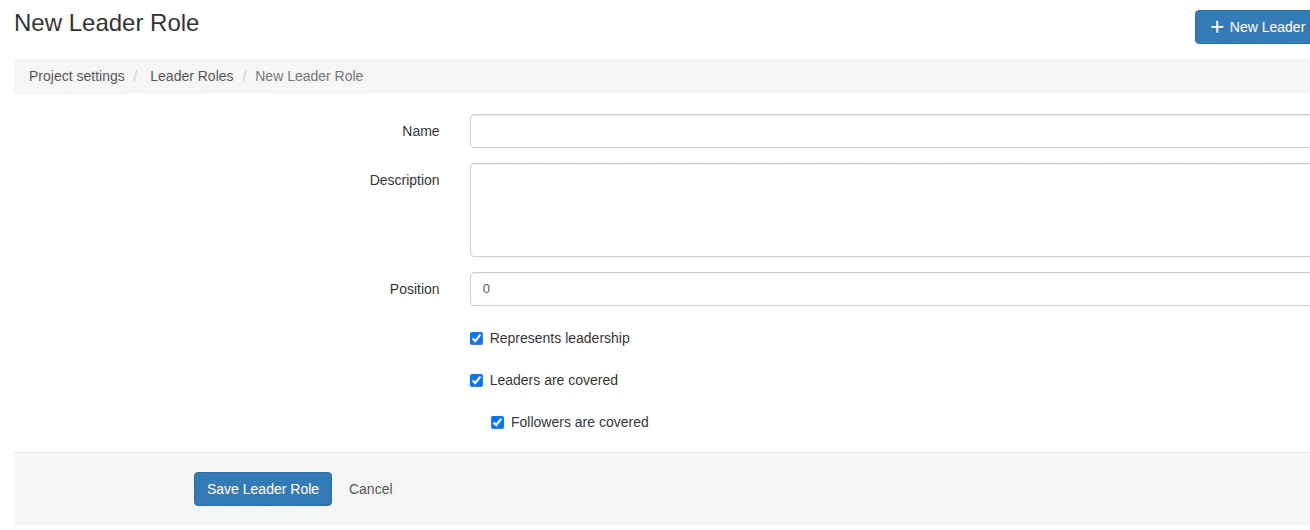
- Click Save Leader Role. You’ll be returned to the leader role index page where all your roles are listed.
- Repeat these steps until you’ve created the roles you need.
Manage roles in the grid
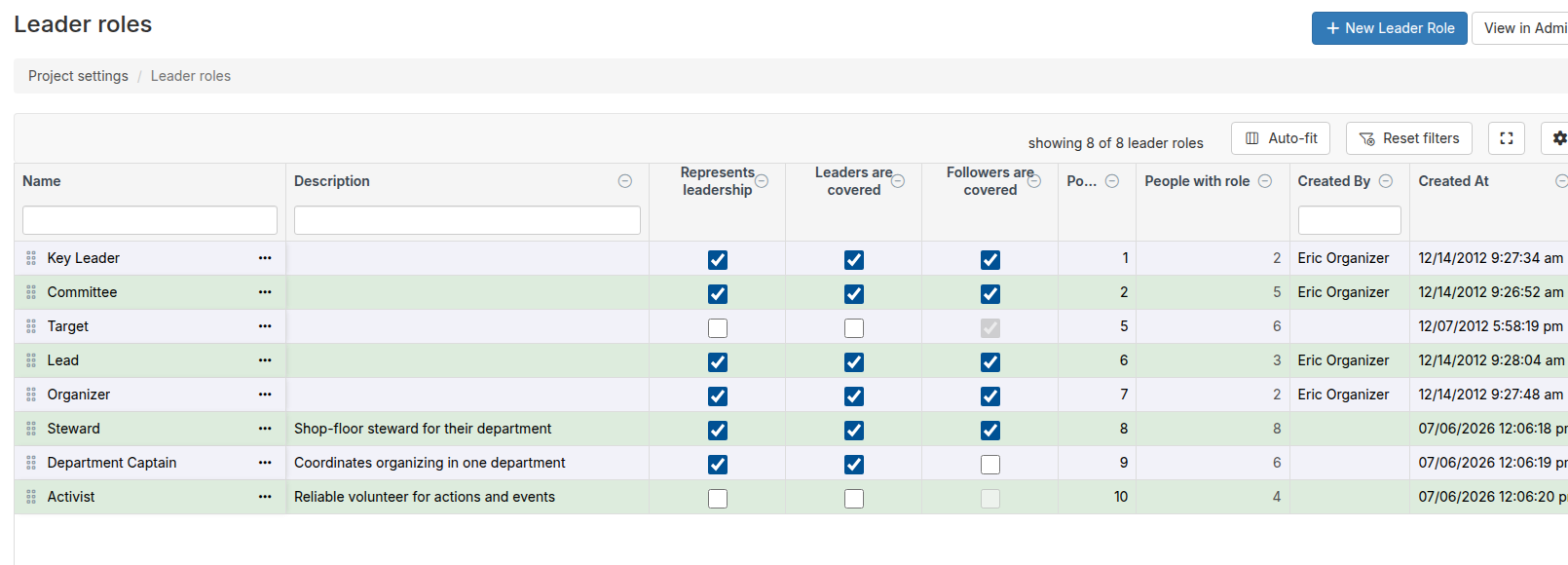
The leader role index page is an interactive data grid. From here you can reorder roles, toggle settings inline, and access edit and delete actions without leaving the page.Reorder roles
Drag any row by its handle on the left side to reposition it in the hierarchy. The Position column updates live to reflect the new order. Dragging is disabled while a column filter is active — clear the filter first to re-enable reordering.Toggle settings inline
Three columns can be toggled directly in the grid without opening the edit form:- Represents leadership — Check or uncheck to control whether this role counts as a leadership role.
- Leaders are covered — Check or uncheck to control whether people with this role count as covered in Broadstripes’ coverage calculations.
- Followers are covered — Check or uncheck to control whether the followers of leaders with this role also count as covered. This option is disabled when Leaders are covered is unchecked.
View leaders in search results
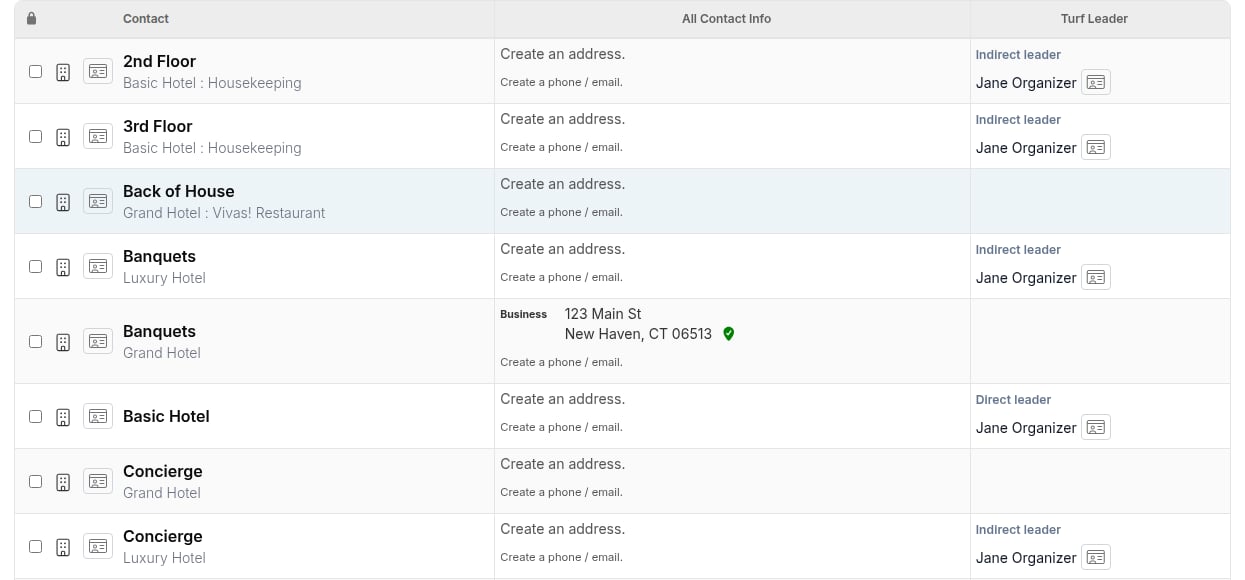
When you add the Turf Leader column to a search layout, each row in your results shows the leader for that contact. For person rows, the column lists the leader of each employer, one per employer. Each leader’s name appears with a Quick View button () next to it so you can open the leader’s record without leaving the search results. For organization rows, the column shows the organization’s leader along with a label that tells you where that leader comes from:- Direct leader means the leader is assigned directly to this organization.
- Indirect leader means the leader is inherited from a parent organization higher up in the hierarchy, because this organization has no leader assigned to it directly.
Edit or delete your leader roles
Edit
- To edit a leader role, click the actions menu () at the right side of the role’s name cell and choose Edit.
- Make the changes you want, and click the Save Leader Role button.
- You’ll be returned to the Leader role index page where you can see your changes.
Delete
- To permanently delete a leader role, click the actions menu () at the right side of the role’s name cell and choose Delete.
- A confirmation dialog appears showing the role’s name and, if any contacts hold that role, how many people will lose it.
- Click Delete to confirm. The leader role is removed from your project, and any contacts who had it will have no leader role assigned.