

- You’ve read Import a spreadsheet — this article picks up in the 2. Define data mappings step.
- Your spreadsheet contains at least one column that identifies existing contacts (see below).
How matching works
Check Match? next to a mapped column, and Broadstripes will use that column to look up existing records instead of blindly creating new ones. For each data row, Broadstripes searches for a record whose field value equals the row’s value (comparison ignores capitalization and surrounding spaces). You can check Match? on more than one column — a row matches only if all the match fields agree on the same record.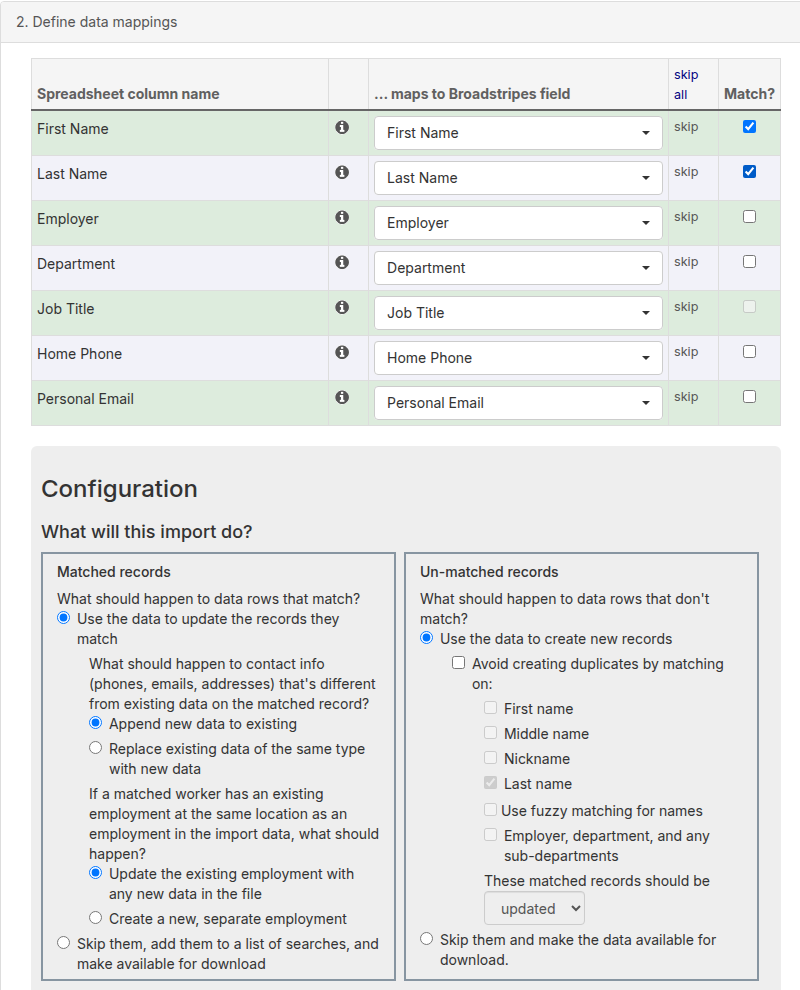
Which fields can be used for matching?
Not every column can be a match key. Broadstripes allows matching on:- Broadstripes ID — the unique ID Broadstripes assigns to every contact. This is the most reliable match key, and it’s included in every spreadsheet you download from search results. When you match on Broadstripes ID, it is used exclusively — no other match fields apply.
- External system IDs — unique IDs from another database (membership number, employee ID, and so on) stored in an external system. Like Broadstripes IDs, these are exact and dependable.
- Phones and emails — any mapped phone or email column.
- First, middle, and last name
- Employer, department, and sub-department — useful in combination with names to narrow matches to a workplace.
It is not currently possible to match on a custom field. If your unique IDs live in a custom field today, see Converting custom fields to external systems.
If you map an external system ID column but don’t check any Match? box, Broadstripes automatically matches on that ID column — external IDs exist to identify records, so imports treat them that way.
Choose what happens to matched rows
As soon as at least one Match? box is checked, the Configuration panel’s Matched records section asks: What should happen to data rows that match?- Use the data to update the records they match — the usual choice. Two follow-up questions tune the update:
- What should happen to contact info (phones, emails, addresses) that’s different from existing data on the matched record? Choose Append new data to existing (keep what’s there, add the new) or Replace existing data of the same type with new data. Your project’s default comes from the Importing addresses, phones or emails setting in General settings.
- If a matched worker has an existing employment at the same location as an employment in the import data, what should happen? Choose Update the existing employment with any new data in the file or Create a new, separate employment. The second option is available only if your project’s Data imports can create multiple employments setting is on.
- Skip them, add them to a list of searches, and make available for download — leave matched records untouched. Skipped rows are counted, searchable, and downloadable after the import, so nothing is silently lost.
Choose what happens to unmatched rows
The Un-matched records section asks the mirror-image question: What should happen to data rows that don’t match?- Use the data to create new records — add rows that didn’t match as new contacts. You can add the duplicate-avoidance name check here as a safety net.
- Skip them and make the data available for download. — only update existing contacts, never create. This is the right choice when you’re syncing data from another system and don’t want strangers added to your project.
What if a row matches more than one record?
If a row’s match fields find multiple existing records, Broadstripes can’t safely choose between them. The row is recorded as an error (“Multiple records in Broadstripes matched the selected fields in the import row”) and no changes are made to any of the candidate records. You’ll see these rows in the import results, where you can download them, fix the ambiguity, and re-import just those rows.A worked example: updating in bulk from a download
The most dependable update workflow is a round trip:- Search for the contacts you want to update, and download them as a spreadsheet with the fields you need. The download includes each contact’s Broadstripes ID.
- Edit the spreadsheet — change values, add columns — but leave the Broadstripes ID column intact.
- Import the spreadsheet. Check Match? on the Broadstripes ID column, and map only the columns you changed (leave the rest on (Skip this field)).
- Under Matched records, choose Use the data to update the records they match; under Un-matched records, choose Skip them — every row in your file came from Broadstripes, so anything unmatched signals a problem.
- Preview, confirm the counts, and Submit.